
WHY DO CATS SCRATCH FURNITURE?
If you ever see your cat scratching furniture or other items, you’ve probably tried your best to stop them to prevent damage. But, why do cats scratch furniture? Scratching is a perfectly normal, instinctive behaviour for cats, genetically built into them.
All cats scratch as an outlet to maintain good claw condition. If your cat has limited access to the outside, they will use items in your home, such as chairs and carpets, to scratch. This also helps stimulate them by expelling energy that is stored from having less freedom compared to outdoor cats.
Whilst cats scratching personal belongings can be considered inappropriate behaviour and frustrating for pet owners, it is important to understand that scratching is healthy for cats.
Today, we will answer the common query, why do cats scratch furniture? We will also discuss measures on how to stop a cat scratching carpets and other household items, and tips to protect your furniture.
Why Do Cats Scratch Furniture?
There are a number of behavioural and psychological reasons behind why cats scratch furniture. This instinctive behaviour stems from a cat’s ancestors, allowing them to survive and thrive in the wild.
According to researchers, Theresa L. DePorter and Ashley L. Elzerman, “Scratching is a highly motivated, natural behaviour with various functions, such as marking territory for communication with other cats through pheromones found in the interdigital glands, sharpening claws, and removing claw sheaths (the outer layer of the claw).”
Scratching, commonly starting as young as 8 weeks of age, allows cats to mark their territory. The chemical release of pheromones from a cat’s scent glands, as well as the visual of torn materials, act as cues of a marked territory, which other cats can detect.
Scratching can relieve stress and tension, releasing chemicals in a cat’s brain that calm feelings of anxiety. Stress is, in fact, the biggest driver in excessive scratching, particularly in households with small children. The act of stretching whilst scratching can also be comforting to cats, just as humans stretch to relieve any aches or pains.
Do Cats Scratch Furniture for Attention?
Whilst there are many possible reasons that answer ‘why do cats scratch?,’ another may be down to attention seeking. Although known as being aloof creatures, cats often crave connection and attention. Therefore, scratching furniture can be a way of getting their owner’s attention.
Cats that continue to scratch furniture when they have designated scratching posts or surfaces may be scratching for attention, but this is not always the case. Sometimes, a cat may start to scratch in preparation to play, release excess energy, or simply show affection. Over excitement tends to encourage excessive scratching in cats, and it can be a sign of happiness and contentment.
Give your cat an appropriate surface to scratch on, such as scratching poles. This can help satisfy their needs and prevent damage to household items. Try to give attention to your cat when they start scratching the item they are allowed to scratch, reward them with a treat to reinforce the positive behaviour. Understanding your cat’s body language is crucial, so observe them carefully to see how they react.
How to Stop Cats From Scratching the Furniture
There are certain steps you can take to stop cats from scratching furniture. One preventive measure to protect furniture is to place a layer of thick, shiny plastic, or silver foil around furniture legs. Cats will not like the feeling when scratching such material, preventing them from returning to scratch in that location again.
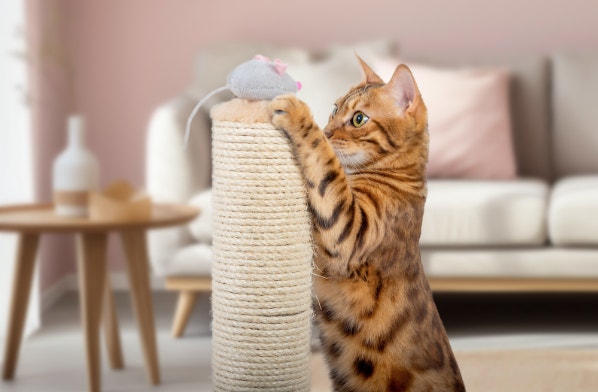
Another effective method is to place a scratching post or pole beside the area where your cat regularly scratches. This will fulfil their need to scratch and protect your furniture at the same time. Ensure you choose the right material as your cat may prefer to scratch upholstery fabric, carpet, wood, sisal rope, or cardboard.
The post should also have a stable, heavy base to prevent it from falling over, and be tall enough for your cat to stretch fully. Moreover, vertical weaves are recommended, as these allow cats to run their claws downwards.
Cats can be stubborn and uncooperative, but challenging them to use other surfaces can stop them scratching beloved items of furniture. Find out some tried and tested tricks to for correcting negative behaviours here.
How To Stop Cats From Scratching Couches and Other Furniture
We understand the answers to ‘why do cats scratch?,’ but stopping them from damaging couches and other common household furniture requires specific strategies.
As mentioned above, covering furniture and using scratching posts can be highly effective. Once a cat starts to use a scratching post, you can gradually move it to another location. For instance, cats tend to stretch and scratch when they wake up, so placing a scratching post or mat near their bed can be impactful.
Other proven methods for deterring a cat from scratching include:
- Placing double-sided sticky tape on furniture - This feels unpleasant for cats and is not harmful.
- Applying citrus-based sprays to couches and furniture - The majority of cats dislike the scent of citrus.
- Cover couches and furniture with protective blankets, covers, or plastic sheets - The cat may continue to scratch, but your furniture will be protected.
What Not To Do When Your Cat Scratches Furniture and Carpeting
It is just as important to understand what not to do when cats scratch furniture or carpets. Firstly, you should NOT declaw a cat. The removal of a cat’s claws and first toe bone is excruciatingly painful and cruel.
Scratching is a natural instinct to cats. They are not out to displease their owners or cause damage purposefully. Therefore, you should not punish your cat when scratching, such as prolonged shouting, spraying them with water, or throwing items in their direction. Punishments can lead to anxiety and fear-based aggressions or other behavioural issues. Due to scratching being an innate behaviour, cats will usually continue to scratch after punishment, but wait until their owner has left the house.
Avoid forcing your cat to use a scratching post, such as placing their claws on it yourself. Cats may see this as a threat and increase levels of fear, anxiety, or aggression.
Positive, strong responses, such as rewards, are recommended for positive behaviour, whilst little to no response is best for inappropriate actions. You can also try having designated time for playing with your cat to help them use pent-up energy.
Point their claws in the right direction
For cats in the wild, claws play an essential part in everyday survival: sharp and strong claws are essential for hunting, self-defence, climbing, balancing, and marking territory. Your understanding of these essential behaviours that are enabled by healthy claws are vital for caring for, and ensuring your cat is happy.
For cats in the wild, claws play an essential part in everyday survival: sharp and strong claws are essential for hunting, self-defence, climbing, balancing, and marking territory. Even when they live in a cosy indoor world, cats retain the instinct to scratch and sharpen claws. To save human furniture from the ravages of the cat’s claws, do equip your home with multiple scratchers, either horizontal or vertical, whatever fits into your home. It doesn’t have to be a scratch pole! It can have any shape. Your cat can also use it as an item of feline furniture to sit on, or a viewing platform. It is very easy to make robust scratch blocks from rolled-up cardboard.
Sharp, strong claws are essential for wild cats to hunt, defend, balance, climb, and mark territory. When indoors, cats retain this instinct to scratch and sharpen their claws, whether it be on furniture, carpets, or designated scratching areas.
By equipping your home with either vertical or horizontal scratchers, you can save your furniture from the wrath of your cat’s claws. You can make your own scratching platforms by using rolled-up cardboard and constructing blocks for cats to scratch and sit atop to view their surroundings.
The next time you ask yourself, ‘why do cats scratch furniture?,’ and you want to know how to stop a cat scratching a carpet, remember that it is completely normal. From sisal rope scratching posts to horizontal scratching mats, there are a range of options to allow cats to continue their scratching habits and protect household items.
Find out more about caring tips and insights into key behaviours here.
Understanding Cat Behaviour
Cats are born predisposed to certain behaviours, such as scratching. Cats are “programmed” to do things that may seem odd to us, but are perfectly natural.
We have found out ‘why do cats scratch?’ but you may be wondering why cats sleep so much. Again, this is instinctive and down to genetics, enabling cats to conserve energy, something that was vital to their ancestor’s survival in the wild.
Other common behaviours that are instinctive to cats include nibbling on grass, knocking items over, being aggressive to other animals, bringing items (birds and mice) to their owners, and licking (a way to groom their fur).
Choosing the Right Scratching Post
When choosing a scratching post for your cat, ensure that it is stable and rigid to prevent it from wobbling or tipping over. It should be tall enough for your cat to fully stretch with enough space to scratch comfortably.
Choose a post with a material that is different to that found in your home to dissuade your cat from scratching those surfaces. You can opt for either horizontal or vertical surfaces to promote claw maintenance, but many cats prefer vertical posts.
If you have a number of scratching posts, keep them away from areas you don’t want your cat to scratch. If you have more than one cat, avoid sharing scratching posts, as this can increase competition and anxiety.
Safe and Effective Deterrents
You can use natural sprays and household remedies as safe and effective deterrents for cats. To make a homemade deterrent spray, mix one part white vinegar with one part water in a spray bottle. Add a sprig of rosemary and a generous amount of fresh lemon juice. When sprayed onto furniture, cats will dislike the scent and keep away, whilst it smells pleasant for humans.
This spray has been proven to be highly effective on leather furniture, causing no damage to the material. Never spray your pet directly, however, as the spray can cause irritation in their eyes and nose.
Monitoring and Adjusting Your Strategy
You can monitor and adjust your strategies to ensure your methods are working. Remember to reward positive behaviours, such as praise, playtime, and treats, as this is more likely to result in repeated actions.
Do not punish or yell at your cat if you find them scratching a surface. Neutrally interrupt the scratching and carefully show them a designated scratching spot, such as a scratching post. You can lure them to these spots using treats or toys. Once they start scratching where you desire, you can reward them.
If some deterrents are not working, try another method, such as placing double-sided tape or aluminium foil on the surface where you wish to stop the scratching.
Seeking Professional Help
You may need to seek professional help from a pet behavioural expert or your veterinarian if your cat’s scratching becomes destructive. Although a normal, innate behaviour, extreme scratching can cause serious damage to household items. If this continues, despite the introduction of scratching posts and training, a behaviourist may be able to help identify underlying triggers and causes.
Excessive scratching with aggression or appetite changes may signal health or stress issues, thus requiring veterinary care. Furthermore, self-inflicted wounds or hair loss necessitates professional help, particularly when deterrents fail.