
How to tell if a cat is pregnant: signs, stages & care

Article checked by a vet
Key signs of cat pregnancy at a glance
You might have bred your cat deliberately, or you might suspect she has an unplanned pregnancy. Either way, it’s important to know how to tell if she really is pregnant and how to care for her if she is.
It’s important to make sure you always have a cat pregnancy confirmed by a vet. It’s often difficult to tell if a cat is pregnant until late in the pregnancy. As well as this, a vet will also be able to rule out a false pregnancy.
How do I know if my cat is pregnant: early signs of pregnancy in cats
Pregnancy is difficult to spot in the early stages, and it often doesn’t become clearly visible until the final 3-4 weeks.
There are normally no signs at all for the first 2-3 weeks, and a cat’s heat cycles will actually continue during this time.
Here are some signs you might start to spot after the first 2-3 weeks:
- Your cat’s nipples might become pinker and slightly swollen (known as ‘pinking up’)
- Your cat might be more docile or attention-seeking than normal
- Morning sickness (vomiting and going off food) might happen after around four weeks
- Your cat might noticeably start to gain weight. Usually, this is not until about four weeks into a pregnancy
Is my cat pregnant or just overweight?
If your cat is gaining weight, it’s important to differentiate between pregnancy weight and weight caused by overeating. Pregnancy weight is concentrated around the belly and feels firmer, whereas an overweight cat carries fat around the legs, neck, and base of the tail.
Make sure you have your cat’s pregnancy confirmed by a vet. It’s easy to miss pregnancy, and it’s also a good idea to rule out a mistake in thinking your cat is pregnant or a pseudopregnancy.
A vet can confirm pregnancy through abdominal palpation from around weeks 3–4, when small walnut-sized lumps become detectable. Your vet will also be able to give your cat a checkup.
Cat pregnancy stages: how long is a cat pregnant?
Cats usually give birth after a 63 to 65 day gestation period, which can be divided into three 21-day trimesters.
Most of the obvious changes won’t happen until the last trimester.
In this section, we’ll look at what to expect at each of the cat pregnancy stages.
Early stage (weeks 1–3)
In the first 1-3 weeks, it’s often hard to tell if a cat is pregnant.
In the first two weeks after conceiving, the eggs won’t even be implanted in the cat’s uterus. At this time, her cat heat cycles will continue, and she can even get pregnant by other tomcats, which could mean kittens in the same litter have different fathers.
Towards the end of this period, the eggs will become implanted, and subtle hormonal changes will begin.
Your cat’s heat cycles will end, and you might start to notice her nipples swelling and becoming pinker (‘pinking up’). You might also notice that your cat starts to become more friendly and attention-seeking, while simultaneously being less tolerant of other pets and disturbances. They may also gain more of an appetite, which is an early first-trimester sign.
As soon as you suspect your cat might be pregnant, it’s important not to press on the abdomen in any way, as this can cause discomfort and could potentially cause harm.
Middle stage (weeks 4–6)
It becomes easier to tell if a cat is pregnant during the second trimester.
After around four weeks, you might start to notice that your cat gets morning sickness, similar to how humans do. She might go off her food or even occasionally vomit. This can happen at any time of day.
Some morning sickness is normal with a pregnant cat, but it’s important to speak to a vet if your cat is vomiting frequently or if you’re worried she’s not getting enough food.
You can also ask your vet to confirm the pregnancy with an ultrasound after around four weeks.
As the second trimester progresses, you might also notice your cat steadily gaining weight. Towards week 6-7, you should notice that she has a nice, round tummy and that her appetite starts to increase. Cats in the second trimester typically become calmer and cuddlier, too.
After you have the pregnancy confirmed by your vet, you should avoid picking up your cat, as this is not only potentially uncomfortable for the mother but is risky for the health of the growing kittens.
Late stage (weeks 7–9)
In the last trimester, it becomes more obvious that your cat is pregnant.
It’s likely that your cat will be more friendly towards you and will seek reassurance and affection from you more often. As well as this, she’s also likely to start showing nesting instincts. This is where she seeks out a quiet, safe and comfortable place to give birth. Normally, most nesting behaviour happens in the last two weeks.
Your cat will also change physically. Her nipples will become more swollen, and she may groom frequently around them or in the area beneath her tail. Milk production will begin in the final week. She will also continue to eat and drink frequently and will visibly gain more weight.
As she gets close to giving birth, she might appear to be anxious or restless.
You should keep your cat indoors for the final two weeks before the kittens are due. This will ensure your cat nests inside and that your kittens are born indoors in a safe, warm home. Otherwise, cats can nest and give birth in hidden outside locations.
Signs your cat is about to give birth
A cat that is soon to give birth will engage in nesting behaviour. This means she will seek out secluded, warm, dark places from around week 7, places that are safe and comfortable for her to give birth in.
She will also stop eating the day before going into labour, and will seem restless or agitated, even scratching at the nesting spot as the moment gets closer.
What does a pregnant cat look like?
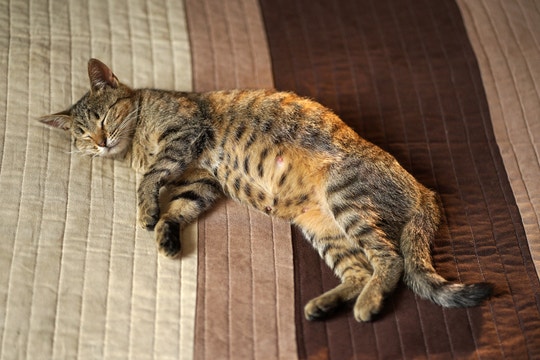
There are a few key visual changes that take place in a pregnant cat. From week 3 onwards, she will begin ‘pinking up’. This means her nipples will swell and turn a more pink colour, and she will likely groom the area more frequently.
After week 5, her belly will begin to round, and by weeks 7–9, she will have a visibly swollen abdomen and clearly enlarged nipples.
Preparing & caring for a pregnant cat
Pregnant cats should, ideally, be vaccinated before pregnancy, but if they become pregnant while unvaccinated, then you should wait until the kittens are born before vaccinating the mother as live vaccines should never be given during pregnancy.
The vaccination and pregnancy should also be coordinated by a vet. Worming and other forms of parasite prevention can continue in pregnancy, and intestinal worms can be passed from a mother to her young through pregnancy and nursing. As a result, it’s important to see your vet about a fecal check. However, it’s crucial that you only use pregnancy-safe medicines.
When it comes to caring for a pregnant cat, it’s important to be gentle with her and make sure she has everything she needs.
Here are the most important things for a pregnant cat:
- A quiet, comfortable location for nesting – Comfortable blankets and sheets, cardboard boxes and purpose built cat beds all make a good choice. Ideally, you will be able to give your cat a choice of locations.
- A good diet – Cats need to eat lots of calories when they’re pregnant. Feed your cat high quality kitten food or cat food designed for pregnant cats. Give her frequent meals, and make sure she has as much food as she wants. Also, make sure she always has easy access to fresh, clean water.
- A stress free environment – Make sure your cat is not put under any additional stress while she’s pregnant. Also, give her all the cuddles and attention she needs to get through her pregnancy.
- Health checks – Keep in contact with your vet and make sure you inform them about anything you think might be an issue.
Pregnancy is a great time to learn about cat health. Not only do you need to care for your pregnant cat, but you’ll soon also have a litter of kittens to look after.
When to call the vet & emergency signs
Cats will normally give birth by themselves without needing a vet. You should aim to supervise the birth from a distance that your cat is comfortable with, in case there is a reason to call a vet.
The main reasons to call a vet during delivery are:
- Prolonged labour: Most cats deliver their full litter within six hours, so prolonged labour is when it takes longer than this benchmark. However, cats can pause labour between kittens for up to 24–36 hours, typically if they do not feel safe, but this is not the same as prolonged labour.
- Heavy bleeding
- If a kitten is stuck in the birth canal
- Visible contractions for more than 20 minutes without a kitten being born
- Extreme lethargy
- Fever
Don’t forget that you also need supplies ready for when your new kittens arrive.